
This post contains affiliate links. If you buy through them, we may earn a small commission at no extra cost to you. We only recommend gear we’ve actually used.
Off-season lacrosse training is the question every club parent starts circling a few weeks after the last tournament: our kid finally has a break — but should they be doing something? Fall ball feels forever away, and none of us want them falling behind.
Before we get to the answer, let us recap where this crazy club lax journey has just been.
These kids have had a stick in their hand weekly — if not daily — for the last three to four months. They worked hard. And just like us as parents, they have been running from state to state most weekends of the summer, plus the occasional mid-week tournament for the older kids. So a few weeks ago, when it finally stopped, we told them (and ourselves) to enjoy the downtime. Our last post, Club Lacrosse Offseason: How to Adjust As Parents, went deep on exactly that.
But here we are a few weeks into the quiet, and the nagging question shows up anyway: should they be doing something?
Here is our honest take: it is completely okay for the answer to be nothing. It is also completely okay to start looking at what is next before fall practices fire back up. For us, the answer depends entirely on the kid. Ours play fall school sports, but those take a back seat to lacrosse in their minds — so right about now they start getting itchy, thinking about what they want to work on and what that could look like.
If your player is in that same headspace, here are the real options — what each one is actually good for, and where each one can go wrong.
First, Know the Trade-Off
The reality is there are a lot of off-season options: wall ball, speed training, strength training, specialized training centers, even mental training. Every one of them has real value. Every one of them also has a real downside — usually cost, time, or pushing a kid who genuinely needs the rest.
So before you sign up for anything, look at the options near you, what fits their schedule, and what will actually move the needle on their development. Do not train for the sake of training. Train for the thing that helps this kid right now.
Wall Ball: The Cheapest Edge There Is
If you do one thing this off-season, do this. Every level of player — youth, high school, college, even the PLL — has wall ball in their routine.
For younger kids, it is the fastest way to stand out. Most kids early on struggle to catch and pass with their dominant hand and cannot use their off hand at all. A young laxer — six, seven, eight years old — who can use both hands? Trust us, they are on the field. As they get older, most club kids get pretty good with their strong hand, but very few get close to equal. The twelve-year-old who can shoot with both hands reasonably well gets noticed. Ask any coach who knows the game: stick skills matter enormously, and a consistent wall ball routine is what builds them.
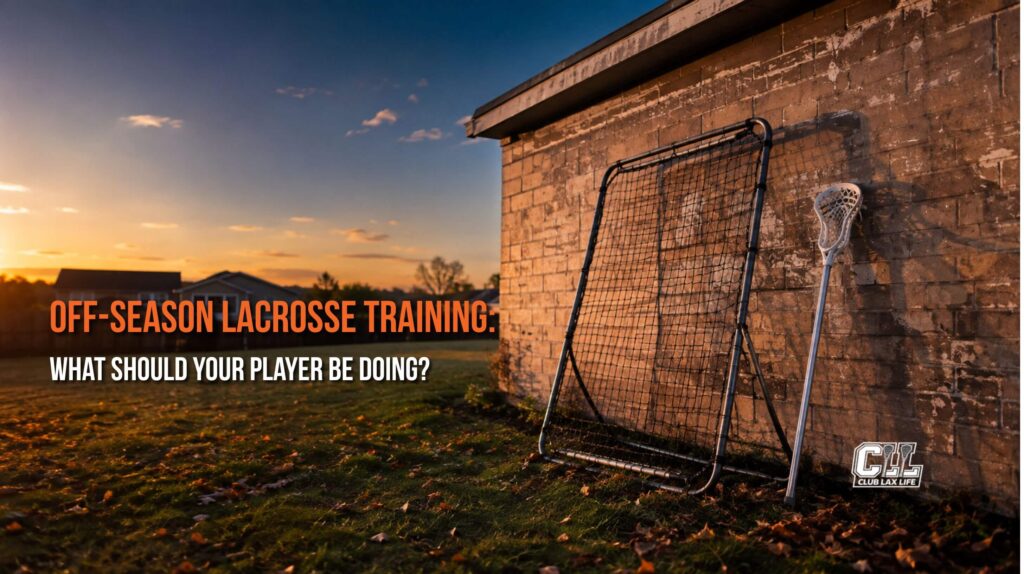
The best part for us as parents — it can cost nothing. There was a school a few miles from us with a couple of great “walls,” and outside of driving them back and forth before they could drive themselves, it did not cost us a dime. Eventually we broke down and bought a rebounder for the backyard. You can spend an insane amount on these; we went with a solid mid-range one that did the trick and lasted years.
We are covering wall ball on its own soon, with the actual routine our kids used — but if your player does nothing else this off-season, get them on a wall.
Speed Training: The Difference-Maker Nobody Talked About
Seven years ago, when our kids started, this was not really a thing — or at least nothing we had heard of. Now the attention and the options have exploded.
We talked about how young kids with stick skills stand out. Sure, a fast seven-year-old gets noticed too — but they still have to catch the ball. By twelve, when most kids have stick skills, the fast kid becomes valuable to any program. Speed training has evolved, and done right, it makes a genuine difference.
A friend of ours had a daughter at a Division I school. After her first college off-season, she went to a local speed-training center a few times a week over the summer. When she got back, a high-level D1 coach told her the difference was remarkable. That tells you two things: speed training can make a real impact while they are still growing, and even at the college level the results show up.
Strength Training: Where Confidence Comes From
Strength work has been around forever, but it has become much bigger in the lacrosse world. We were hesitant to let our kids start young, and looking back, that may have been a mistake.
As they hit the teen years, strength matters. Boys lacrosse from fourteen on is a physical game — they need strength to compete, and being strong builds a world of confidence. Our son struggled through the eleven-to-thirteen stretch because he was small and, honestly, not very strong. What changed it? He got serious about strength training and put on twenty pounds of muscle. Suddenly he could compete physically — and just as importantly, he knew it. He believed it, and his confidence soared.
Specialized Training Centers: Great Coaches, Real Cost
Also fairly rare seven years ago, these seem to be popping up everywhere now. Most are run by former college players. Yes, they are out to make money — as they should — but the good ones genuinely love the game, understand it, and most importantly love teaching kids.
Some have gotten seriously technical: shooting schools, dodge schools, goalie training, defensive training, and now a lot of them fold in speed and strength work too. The best are detailed across all of it. The catch is simple — this is the option that costs the most, so make sure it is solving a specific problem your player actually has.
Mental Training: The One We Wish We’d Used
Stick with us on this one. There are not many out there yet, but they are starting to appear — and looking back, we see a lot of value in them.
Your child can have the best stick skills, be the fastest and strongest kid on the field, and have a great shot — but if they do not have confidence, they will never reach their full potential. And the mental side is more than confidence. It is how they handle losing, how they respond to a mistake, how they reset. There is a real science to it, and we have heard some genuinely good results.
Our kids never used one. If we were doing it over again, we would at least look.
The Bottom Line
Back in our very first post, Is Club Lacrosse Worth It?, we said the whole thing only works when the kid truly loves the game. The off-season is no different. If your child loves lacrosse and wants more when the season ends, there is a ton out there for them.
So do not train them because you are anxious about fall ball. Sit down with your player, ask them what part of their game they want to improve, and then find the option that fits their goals — and your family’s schedule and budget. Sometimes that is a rebounder in the backyard. Sometimes it is nothing at all. Both are the right answer when they come from the kid.
Want More of This?
We are digging into a few of these deeper in the coming weeks — starting with the wall ball routine our kids actually used. From off-season training to the honest stuff nobody warns you about, we cover club lacrosse from parents who have lived every season of it. Join the ClubLaxLife family and get real insights in your inbox.
CLL